Showing posts with label existential risk. Show all posts

Friday, November 12, 2021

Eco-anxiety, Krystallnacht and the pathologizing of existential risk

Writing in the New England Journal of Medicine, Dr Nitin Ahuja states "By pathologizing the existential questions raised by global warming rather than the warming itself, health care authorities position themselves as responsive rather than vulnerable to the coming upheaval." The American Psychological Association (APA) formalized “ecoanxiety” as a mental health diagnosis. Ahuja notes that although a report on the subject, by the APA, includes recommendations to “foster optimism” and “support national and international climate–mental health solutions,” it does not mention any specific carbon-reduction efforts, individual or collective, that might forestall climate change in the first place“support national and international climate–mental health solutions.

 
However, to be fair, the APA report (published 2017) has a large section on the health effects of climate change. It is not, in any sense, dismissive of the topic - though the word "activism" is not mentioned.
 
It's perhaps not fair to contemporary psychologists, but reading the opening sentence (above) by Ahuja reminded me of a conversation at a reception for new staff with a recently arrived academic psychologist at the Australian National University in about 2011. I was just starting to supervise a PhD student whose topic was climate change, conflict and public health (my student had trained in psychology among other things). I tried to explain the topic to a potential ally. But she responded not with a diagnosis of "eco-anxiety" but "existential angst". To which I said "if you were Jewish during Krystallnacht and you felt anxious, would you dismiss that as unjustified anxiety?" That must have been too confronting; she immediately moved away. 
 
Donald Trump repeatedly dismissed Greta Thunberg's eco-anxiety. In so doing, he must have felt he had the support of millions of people of his generation - men and women who have benefitted from fossil fuels, but whose future is increasingly precarious. The current rise in the price of food and many other goods in the US and elsewhere is not only to do with the economic recovery from the pandemic, but also climate change (affecting crops) and the rising price of oil. Many of Trump's most loyal supporters are especially vulnerable.
 
Before WWI, Carl Jung had a prophetic vision which is easily interpretable as a premonition of the war - though he dismissed it at the time (described in his autobiography Memories, Dreams, Reflections). Sometimes, people do sense what is coming. Ignoring such warnings risks chaos.
 
President de Klerk made, as one of his final statements, a deep apology to the non-Caucasian people of South Africa. Will coal-loving Australian prime minister Scott Morrison and his fellow travellers one day come to rue their stubborn and unscientific views about climate change and other aspects of limits to growth? It does not seem very likely, but de Klerk's views changed.

Health journals are awakening to the existential risk to well-being, and even to human survival, that untrammelled climate change represents. So must the general population. Eco-anxiety is painful, but justifiable. Its only remedy is emergency action to cool the planet. The first step for that is to move rapidly away from all forms of fossil fuel, and switch to electricity powered by the sun, wind and falling water. We must also reduce animal farming.

Sunday, October 14, 2018

Climate change, health and existential risks to civilization: a comprehensive review (1989-2013)

International Journal of Environmental Research and Public Health (published October 16, 2018)

See here for full text (open access)

Abstract:  

Background: Anthropogenic global warming, interacting with social and other environmental determinants, constitutes a profound health risk. This paper reports a comprehensive literature review for 1989-2013 (inclusive), the first 25 years in which this topic appeared in scientific journals. It explores the extent to which articles have identified potentially catastrophic, civilization
endangering health risks associated with climate change.  

Methods: PubMed and Google Scholar were primarily used to identify articles which were then ranked on a three point scale. Each score reflected the extent to which papers discussed global systemic risk. Citations were also analyzed.

Results: Of 2143 analyzed papers 1546 (72%) were scored as one. Their citations (165,133) were 82% of the total. The proportion of annual papers scored as three was initially high, as were their citations but decline to almost zero by 1996, before rising slightly from 2006.

Conclusion: The enormous expansion of the literature appropriately reflects increased understanding of the importance of climate change to global health. However, recognition of the most severe, existential, health risks from climate change was generally low. Most papers instead focused on infectious diseases, direct heat effects and other disciplinary-bounded phenomena and consequences, even though scientific advances have long called for more inter-disciplinary collaboration.

Keywords: citation analysis; civilization collapse; climate change; comprehensive review; conflict; existential risk; famine; global warming; global health; migration

Wednesday, October 3, 2018

Climate change and health: Tony McMichael and an "index of existential risk"

It's another average day for me, except that that, were Tony McMichael still alive, it would be his 76th birthday. Tony was one of the the first leading figures in public health to recognize the risk to human health from climate change.

The trough in the annual cycle of carbon dioxide levels is now over 405 ppm (parts per million). The Federal President of the Young Liberals has just pronounced that Australia should not take any leadership role in tackling climate change. Even more worryingly, he has suggested that the billion or so people without electricity should be illuminated by coal burning. (But Indian President Modi does not agree (see endnote - PPS)). The lead author of a new article on ancient climate (about 50 million years ago) has just been quoted as saying that “Some climate models suggest that the tropics just became a dead zone with temperatures over 50 degrees Celsius (122 degrees Fahrenheit) like in Africa and South America.. but we have no data so we don’t know.” At the time he was discussing (called the early Paleogene), carbon dioxide levels may have been 1000 ppm.

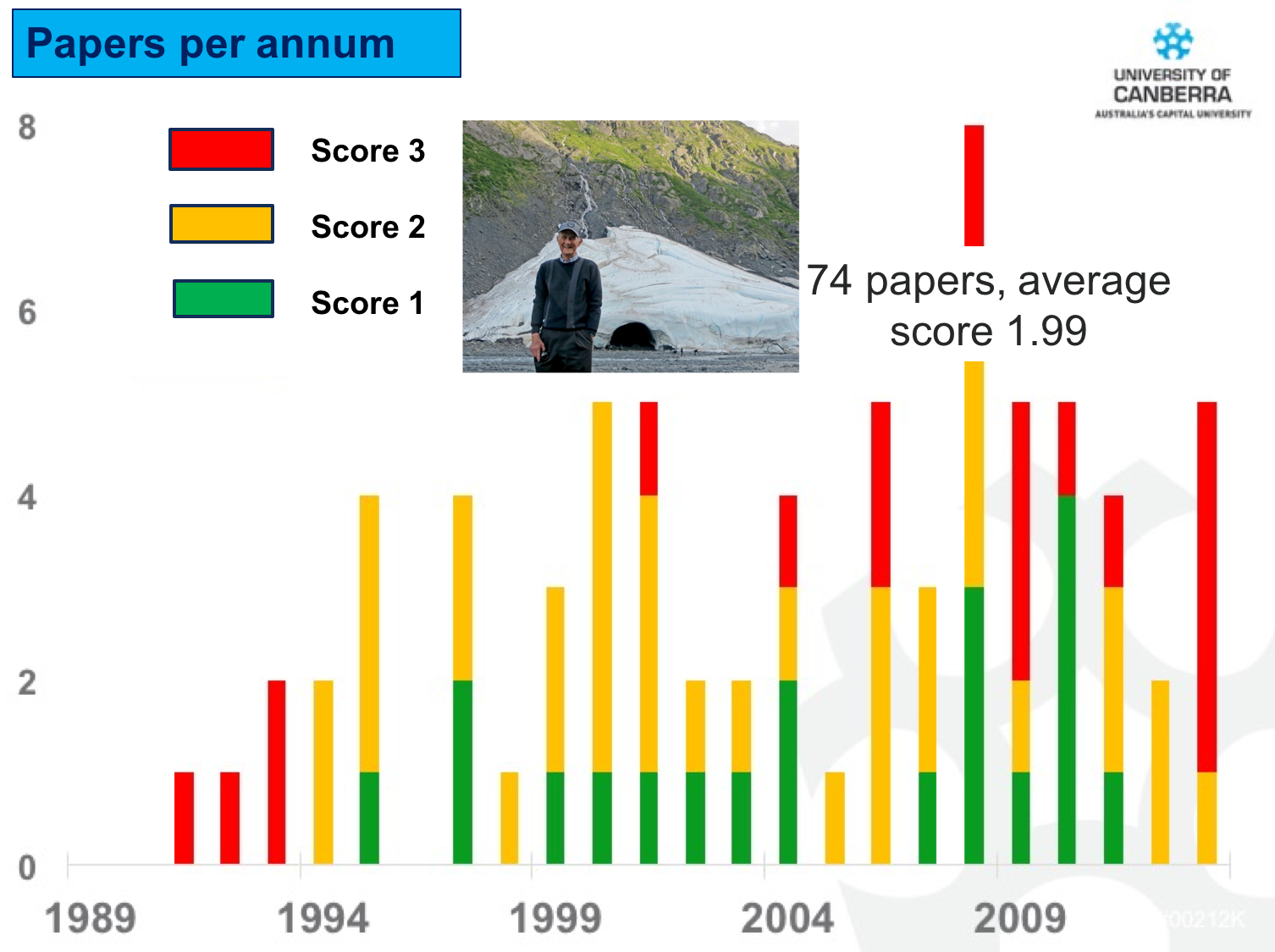
I have an article under review which reports an "index of existential risk" for climate change and health, identified in the climate and health literature. I looked at 2,146 articles, editorials and news items, published in the first 25 years of this literature (1989-2013 inclusive). Each paper was given a score between 1 and 3, depending on the degree to which they recognized that climate change may pose an "existential risk" to civilization, and thus health. The average score of these papers was 1.37. 

The average score of Tony's 74 papers was 1.99 (see figure). I mentioned this last week, when I had the chance to talk at the Public Health Association of Australia's 2018 conference, after I received the 2018 award for public health, ecology and environment, named after Tony McMichael. The slides for my talk ("From life support to regional overload") are here

The press release for this award stated that I see civilization at risk, not life, if we continue the current trajectory of fossil fuel burning (and other approaches to planetary boundaries). This is not because it may become so warm that there may again be crocodiles and palm trees in the Arctic Circle, but because the chaos that will be inflicted upon human society through many processes associated with "regional overload" (of which unfavourable climate  change is but one) are likely to outweigh human coping capacity. Here are three candidate contributors, in no order: (1) drought, heat and rising food prices triggering more political instability; (2) sea level rise on the US East Coast leading to a massive loss in property values and thus worsening a financial crisis; (3) a mass human flight from north east China later this century, due to intolerable heat and humidity. 

Even now, solutions might be found. The technology for electricity and elective transport is rapidly advancing. California seeks to be 100% carbon free by 2045. Education reduces fertility (reduced fertility in many settings is important, not to slow climate change, but to reduce climate change related catastrophes in the global South). But these solutions need high level recognition by our political leaders, and that needs the global middle class to understand that rapid transition, towards sustainability, is both urgent and attainable.   

PS Later this month I am teaching, in Finland, in a short course on climate change and health, based on my edited book. (I have just agreed to edit a second edition but it will take some time.)

PPS Prime Minister Modi is reported as saying that:
1. He saw the 121 country International Solar Alliance as the future OPEC for meeting energy needs of the world
2. India would add as much as 50 GW (gigawatts) of non-hydro renewable energy to its existing 72 GW and is on track to reach its target of 75 GW of clean energy by 2022
3. That India’s solar energy increased by nine times in the last four years
4. That in the next four years as many as 28 lakh (2.8 million) solar pumps would be installed which would help avoid 10 GW generation capacity. 
5. 31 crore (310 million) LED bulbs were distributed

50GW is a lot - according to the 2018 Clean Energy Report less than 6 GW of large scale renewable energy projects were under construction or expected to start in 2018, in Australia.


Tony McMichael's 74 papers (1989-2013 inclusive) on climate change and health, scored by their recognition of existential risk.