Showing posts with label Tony McMichael. Show all posts

Friday, October 15, 2021

Coal Harms Health: Climate Change and Health, Past, Present and Future

Hello everyone. It’s a great pleasure to be speaking (October 16, 2021) at the 20th anniversary conference of Doctors for the Environment Australia (DEA); I’d like to thank the organisers and to acknowledge the traditional owners, the Kuarna people. I’d also like to congratulate DEA for no longer being a teenager and for having over 2,500 members. I can recall when there were fewer than ten.

The organisers asked me to prepare no slides but with one exception – I am thus calling my talk “Coal harms health”. This photo was taken near Maules Creek coal mine, in 2014. It’s an export mine; from there coal is taken by train, through the air-polluted Hunter Valley, to the coal dust contaminated city of Newcastle, where I studied medicine. This protest was organised by the Australian Religious Response to Climate Change; my support team were devout – even if they look scruffy.


While waiting to be arrested I was holding this book – the first edition of “Climate Change and Global Health”, which had just been published, and which I edited. 


At that time I had also just contributed to the health chapter of the 2014 IPCC report, thus I was the first IPCC health contributor to be arrested for what could be called “climate disobedience”.  I take the issue of climate and health seriously, and I also take seriously the issue of climate justice – the main reason I chose arrest was to protest at the immorality of rich Australia profiting from the export of a substance clearly harmful to health, especially future health. I also lament the decline of ethics in science.

If this was not virtual I would ask for a show of hands: who attended the first iDEA conference, in Melbourne in 2009? I did – in person of course. My talk there focussed on the “tertiary” – or catastrophic - health consequences of climate change, including conflict, war and famine. The first editorial on climate change and health – in The Lancet in 1989 – hinted at these issues. However the topic is still vastly under-recognised, despite the implications of Will (and other’s) work. For me, the risk of runaway climate change (or Hothouse Earth) is terrifying, and trying to prevent that has now motivated me for 3 decades. We are making progress but there is enormous work ahead.

Since the early 90s I have used a three-way categorisation of how climate change will impact human health and well-being. In addition to tertiary effects are what is generally called direct and indirect, or “primary” and “secondary”. I based the first and forthcoming editions of my edited book on these categories.

By “primary” health effects Andy Haines and co-authors meant comparatively obvious things, such as heat stroke. Of course, nothing is simple, but I ask you to consider the field at a time when the existence of anthropogenic climate change was challenged by most, and when, for conservative doctors, links between it (as opposed to climate) and health were considered speculative. Thus tertiary health effects were a largely no go area at that time.

Temperatures in the high 40s in Australian cities were unimagineable when I was at medical school, they now seem almost unremarkable. Extreme heat has adverse effects that are pretty well-known; such as heat strain and heat stroke. Their risk is worsened by high humidity; indeed in some parts of the world, in the near future (without emergency climate action), the combination of heat and humidity will be fatal, even without exercise. Thus some areas of the planet will literally be uninhabitable, at least for some times of the year. Heat strain is an incredibly important issue for occupational health, especially for outdoor workers in already hot places and for emergency workers wearing protective clothing in hot conditions. Heat strain may also have a “long tail” of adverse effects, including on some chronic diseases – especially people with pre-existing cardiovascular disease. What happens to people who are vulnerable but who recover? It seem unlikely that they all return to their previous level of function. I believe this question remains under-explored.

An important co-author of that early work on primary, secondary and tertiary effects was the late Tony McMichael. Tony, with David Shearman, were the true founders of DEA. Both were far ahead of their time; with viewpoints best called “ecological.” Tony’s most influential book, published in 1993, was called “Planetary Overload”. Four years later, David’s book “Green or Gone” was published.


Four years after, DEA was born, and now it is 2021.

Some of you will have heard of the UN Conference on the Human Environment, in Stockholm: 1972. More will have heard of the Rio Earth Summit, 20 years later. The main organiser for these meetings was Maurice Strong; he was also founding director of the UN Environment Programme.

His autobiography, “Where on Earth are We Going?” was published in 2001. It starts with a report to the shareholders, from 2031; a world of profound disorder, massive forest fires, including Siberian, and famines, droughts, floods, conflict, refugees, plague and “Virus X”. Global population is below five billion; it is, today, about eight. These risks arise not only from climate change, but as Kerryn Higgs, a co-editor for the 2nd edition of Climate Change and Global Health, says, endless growth on a finite planet is a collision course.


Hopefully Strong’s forecast is too pessimistic. However, global life expectancy has fallen due to the pandemic; hunger has risen, and foodprices are at a 10 year high.

There is risk from exaggeration, but also from under-statement. Pessimism paralyses; understatement generates complacency. I believe it is our duty to sound a warning. Prevention is better than cure. Past civilisations have collapsed; ours could too.

But I will end with hope. Activism lifted Greta Thunberg from depression, and is an important antidote to despair; as is fellowship. Getting arrested – even here – is serious; consequences can be unforeseen. I was unable to attend the inaugural planetary health conference in New York because a timely visa was denied.

Protest is necessary, but not sufficient.

Last month, over 230 medical journals jointly published an editorial (includiung in the Medical Journal of Australia) calling for “emergency action to limit global temperature increase, restore biodiversity, and protect health.”

That is progress. So is the growth of DEA and the involvement of so many medical colleagues and colleges in this struggle, globally. The link between the health of our planet and the health of people is now widely accepted. Tough times are ahead, but together we can make a great difference.

Thank you.  

Wednesday, October 3, 2018

Climate change and health: Tony McMichael and an "index of existential risk"

It's another average day for me, except that that, were Tony McMichael still alive, it would be his 76th birthday. Tony was one of the the first leading figures in public health to recognize the risk to human health from climate change.

The trough in the annual cycle of carbon dioxide levels is now over 405 ppm (parts per million). The Federal President of the Young Liberals has just pronounced that Australia should not take any leadership role in tackling climate change. Even more worryingly, he has suggested that the billion or so people without electricity should be illuminated by coal burning. (But Indian President Modi does not agree (see endnote - PPS)). The lead author of a new article on ancient climate (about 50 million years ago) has just been quoted as saying that “Some climate models suggest that the tropics just became a dead zone with temperatures over 50 degrees Celsius (122 degrees Fahrenheit) like in Africa and South America.. but we have no data so we don’t know.” At the time he was discussing (called the early Paleogene), carbon dioxide levels may have been 1000 ppm.

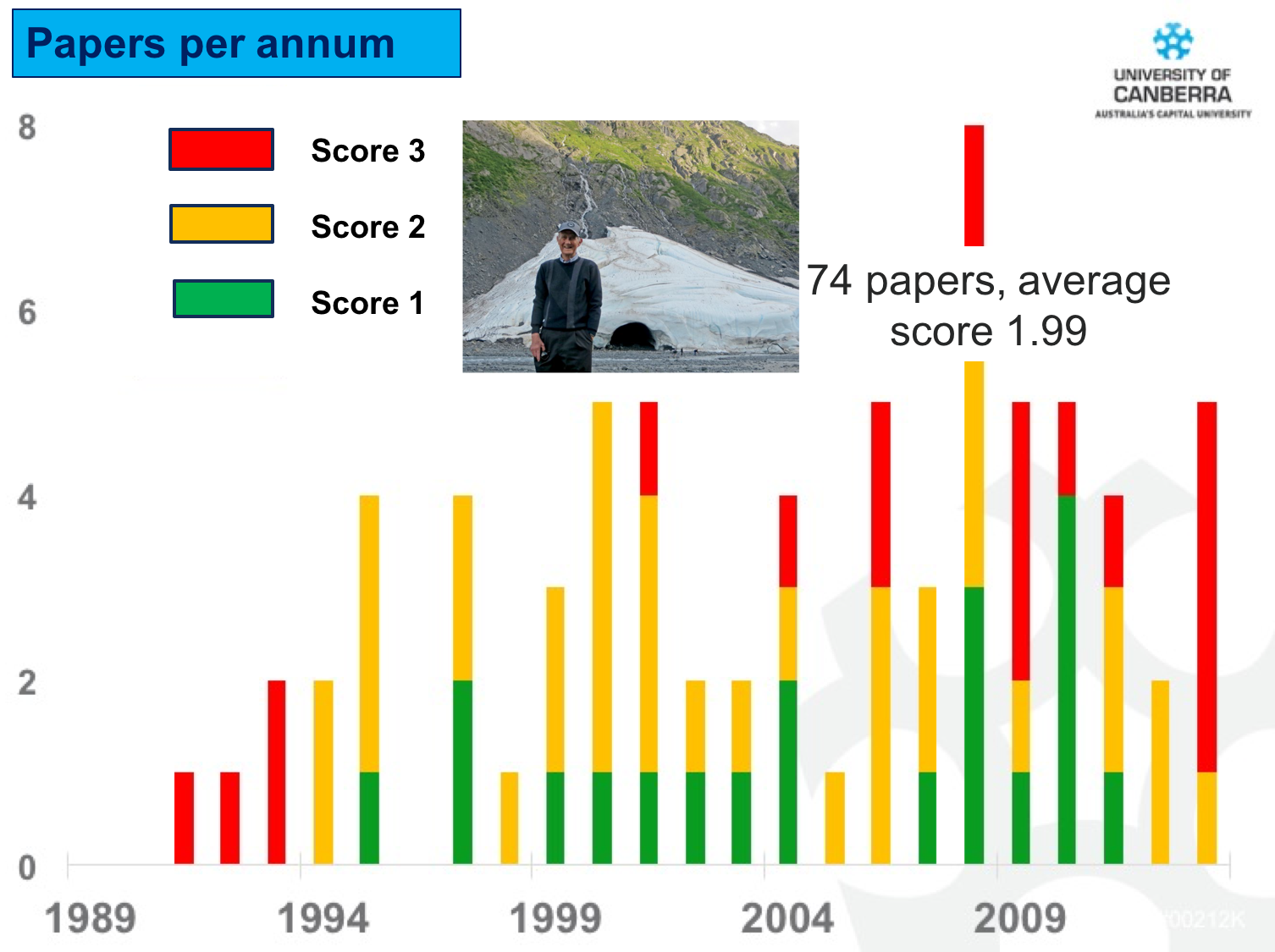
I have an article under review which reports an "index of existential risk" for climate change and health, identified in the climate and health literature. I looked at 2,146 articles, editorials and news items, published in the first 25 years of this literature (1989-2013 inclusive). Each paper was given a score between 1 and 3, depending on the degree to which they recognized that climate change may pose an "existential risk" to civilization, and thus health. The average score of these papers was 1.37. 

The average score of Tony's 74 papers was 1.99 (see figure). I mentioned this last week, when I had the chance to talk at the Public Health Association of Australia's 2018 conference, after I received the 2018 award for public health, ecology and environment, named after Tony McMichael. The slides for my talk ("From life support to regional overload") are here. 

The press release for this award stated that I see civilization at risk, not life, if we continue the current trajectory of fossil fuel burning (and other approaches to planetary boundaries). This is not because it may become so warm that there may again be crocodiles and palm trees in the Arctic Circle, but because the chaos that will be inflicted upon human society through many processes associated with "regional overload" (of which unfavourable climate  change is but one) are likely to outweigh human coping capacity. Here are three candidate contributors, in no order: (1) drought, heat and rising food prices triggering more political instability; (2) sea level rise on the US East Coast leading to a massive loss in property values and thus worsening a financial crisis; (3) a mass human flight from north east China later this century, due to intolerable heat and humidity. 

Even now, solutions might be found. The technology for electricity and elective transport is rapidly advancing. California seeks to be 100% carbon free by 2045. Education reduces fertility (reduced fertility in many settings is important, not to slow climate change, but to reduce climate change related catastrophes in the global South). But these solutions need high level recognition by our political leaders, and that needs the global middle class to understand that rapid transition, towards sustainability, is both urgent and attainable.   

PS Later this month I am teaching, in Finland, in a short course on climate change and health, based on my edited book. (I have just agreed to edit a second edition but it will take some time.)

PPS Prime Minister Modi is reported as saying that:
1. He saw the 121 country International Solar Alliance as the future OPEC for meeting energy needs of the world
2. India would add as much as 50 GW (gigawatts) of non-hydro renewable energy to its existing 72 GW and is on track to reach its target of 75 GW of clean energy by 2022
3. That India’s solar energy increased by nine times in the last four years
4. That in the next four years as many as 28 lakh (2.8 million) solar pumps would be installed which would help avoid 10 GW generation capacity. 
5. 31 crore (310 million) LED bulbs were distributed

50GW is a lot - according to the 2018 Clean Energy Report less than 6 GW of large scale renewable energy projects were under construction or expected to start in 2018, in Australia.


Tony McMichael's 74 papers (1989-2013 inclusive) on climate change and health, scored by their recognition of existential risk.

Monday, October 10, 2016

Reflections on Emeritus Professor David Shearman’s contribution to Doctors for the Environment, Australia

This is the text of a talk I gave at a Doctors for the Environment, Australia (DEA)
Annual General Meeting, September 30, 2016 Adelaide, South Australia.
           
It is a great honour to be asked to comment on Emeritus Professor David Shearman’s contribution to Doctors for the Environment Australia. I first heard David’s name in 1998, during an interview by Norman Swan on the ABC’s Health Report. I can recall the moment, in Tasmania, driving towards the Eastern Tiers; I was impressed that a gastroenterologist would care so much about the environment and understand its deep connections with health. This interview was about his book, co-authored with Gary Sauer-Thompson, called 'Green or Gone. Health, ecology, plagues, greed and our future'.
In this book I learned that David participated, as an intern, in the first ever renal transplant, undertaken in Edinburgh, Scotland, in 1962. At that stage stage I had no idea that I would ever meet David, let alone work with him. However, I had heard of DEA’s parent group, International Society of Doctors for the Environment (ISDE), and had met some of its representatives, when I was studying in London.

About then David met with Dr Gaudenz Silberschmidt, then ISDE’s Executive Officer, based in Switzerland, who had steered it through a successful first decade. In 1999 David met with Professor Tony McMichael, then based in London. They agreed to explore establishing an Australian branch of ISDE. David then visited Geneva to discuss this with Dr Silberschmidt.

David writes, in the history of DEA that the first task was to find a chairman. Bill Castleden, a surgeon, who had led a movement to protect old growth forests in the south west of Western Australia was identified, and pursued. Bill’s notes on this provides an eloquent insight into David’s character:

Within weeks of giving up day-to-day forest involvement in 2001, I started to receive emails from a Professor David Shearman in Adelaide asking if I would be interested in joining a group of doctors he wanted to assemble to alert the public and the government about the close connection between a healthy environment and healthy human beings.
I ignored his emails. I had had enough of campaigning for Doctors for the Forests in Western Australia.

And still David Shearman persisted. He wrote of his almost lifelong commitment to environmental causes, of his past-Chairmanship of the South Australian Conservation Council and his book writing and his publications. After months of email bombardment and discussions with Wendy, we agreed that we would go for a weekend to the Mornington Peninsular south of Melbourne to meet the potential steering group of doctors he had collected from each State. I was not really sure what it was all about or if they were all too deeply green to be reasonable human beings!

In 2001 and 2002 two teleconference were held, leading to our first actual meeting. This was held in October 2002 in a beautiful setting lent to us by Grant and his wife, who was related to the late Ron Castan, a barrister and human rights advocate who had played a leading role in several landmark legal cases, most notably that in which the High Court acknowledged the land rights of Eddie Mabo and his family.

Commemorating Ron Castan’s life, Justice Michael Kirby wrote

“In two hundred years time they will still talk of Mabo. There was no more radical design than that which Ron Castan conceived with his colleagues to rewrite 150 years of settled land law. It was a plan breathtaking in its boldness. It challenged fundamentals. It did so in an area traditionally resistant to change in every legal system - rights in land.

The Court, beckoned by the advocacy of Ron Castan and those of like cause, rewrote the major premise. In a moment, 150 years of terra nullius was cast aside. A new chapter in the legal rights and national dignity of Australia's Indigenous peoples was begun.

I think it was worth reading this, not only because our next speaker (Julian Burnside QC) is a lawyer, but to remind ourselves of how racist the concept of terra nullius is. Unfortunately, there are many other laws and concepts which are also extremely unfair, including how we relate to Nature.

I digress: that meeting in Victoria was my first face to face meeting with David and his wife Clare.

Bill wrote about this:

David had carefully constructed a full weekend of meetings and presentations during which we had ample time to assess each other’s possible strengths and weaknesses. Over the final lunch and afternoon he had asked Don Henry, Executive Director of the Australian Conservation Foundation and David Yencken of the Australian Collaboration to come to meet and talk with us. They made us feel we could, as a medical organisation, play a very important role in the overall effort to ensure a healthy environment for the next generations of Australians to grow into.

Our egos suitably massaged, we all agreed to set up DEA. David Shearman with his amazing persistence undertook to complete the necessary paperwork.

There is an impressive list of DEA’s achievements, to which many of you have contributed. Too many to read here, they include journal and magazine articles, position papers and a series of medical student led conferences. There were also many meetings with politicians and posters in schools and GP surgeries. There were at least two grants, including from the Poola Foundation and the Federal Environmental Education Research programme. Membership has grown steadily - there are now 260 medical student members - and since 2010 DEA has employed a full time administration Officer. DEA is a team effort, but I truly believe our achievements would have been far less than half, without the leadership, persistence and decency of David.

For several years I represented DEA to ISDE. I report that few, if any, of the other recent and current national ISDE affiliates have had anything like the success and influence of DEA in their own countries, at least in recent years. This is not intended as a criticism of them, because it is extremely hard to combine a career with running an NGO. And it is also not easy to do this after retirement. My main purpose is to stress how remarkable David’s contribution has been.

Director General of WHO, Dr Margaret Chan, recently wrote: “Climate change is one of the greatest challenges of our time. Climate change will affect, in profoundly adverse ways, some of the most fundamental determinants of health: food, air, water. In the face of this challenge, we need champions throughout the world who will work to put protecting human health at the centre of the climate change agenda.”

David is one such champion.

In recent years we have seen numerous heat records and record breaking storms, including in Fiji and the Philippines. Two percent of the Tasmanian world heritage highlands burned last summer, set fire by innumerable lightning strikes. In May this year, northern Tasmania experienced record-breaking floods.

Along the Great Ocean Road, the town of Wye River was first burned, then more recently flooded. Landslides, worsened by the cutting of burned trees on steep hills, have since blocked roads. There has been considerable economic distress. Much of the Great Barrier Reef has been bleached, and along the Gulf of Carpentaria, at least 10,000 hectares of mangroves have died back, apparently from abnormally warm sea surface temperatures and reduced river flows.

All of these things – more intense drought and more intense floods - have long been predicted by climate scientists, including increased lightning. In South Australia’s storm this week, electricity pylons fell like bowling pins and the whole state was blacked out for hours. Some towns are still blacked out. Mobile phones failed and so did internet access and a back up generator at a hospital.

There were thousands of lightning strikes, but no forest or grass fires. We can hope it will be another 50 years until this so-called “one in 50 year event” recurs, but that could be wishful thinking. One thing that will not take 50 years is the next coastal flooding, as the sea level continues to rise, and its rate of rise increases. The longest pier in the Southern Hemisphere, at Port Germein was damaged by high tides a few months ago and repaired. It has again been damaged, and it needs further repair. 

Along the Lachlan River, in NSW, they have had floods, and the wheat harvest will be reduced. Frosts are occurring later in spring, despite a well-documented warming trend. These events are linked; the building blocks of civilisation, particularly a stable ecology and climate system, are being harmed.

Climate change was also identified as a contributor to conflict and migration, in papers published in 1989 in the Lancet and New England Journal of Medicine. These are topics relevant to our next speaker.

In summary, factors which motivated the foundation of ISDE and DEA remain more urgent than ever. Perhaps the only good thing is that the evidence of climate change is now so obvious that deniers are not taken very seriously. But much more needs to be done. For example, there have been attempts to link wind energy in SA with the state’s blackout, a process which confuses electricity generation with its transmission. There are some technical engineering issues with integrating wind energy into the grid, but the problems that climate change is already starting to deliver will be orders of magnitude greater. The time for national leaders to focus on trying to overcome these grid problems rather than promoting more coal or gas is long overdue. Both the ACT and Scotland plan to reach 100% of their electrical energy by 2020 from wind and solar; this engineering problem definitely can be solved. However, left another generation, the problems of climate and adverse ecological change may not be soluble. As David and Gary wrote in 1997, we must be Green or else we will be gone.

Thank you David, for your energetic and wise leadership, not only for DEA but for the national and the international movement for environmental and social justice.

Tuesday, June 2, 2015

Climate change as a health threat: reflections on two papers in the Lancet


This is a slightly modified and longer version of an essay I wrote for Croakey, called "Climate change a great threat to health, but not as generally conceived". In the months leading to the 2009 Copenhagen climate change conference the Lancet published an unusually long (41 page) article called “Managing the health effects of climate change”. The text postulated that “climate change is potentially the biggest global health threat in the 21st century” but the executive summary was subheaded: “Climate change is the biggest global health threat of the 21st century”. 

Later this month, in the lead up to the Paris climate change summit, the Lancet is to again publish a major report on climate change and health. I had no role in either commission, though in 20014 my edited book on the subject came out. (It is to be reprinted with a new chapter in a softcover version by mud-2016.)

From 2008 until late in 2009 I was part of a WHO-led team which was trying to update the earlier study on the burden of disease (BOD) of climate change. We eventually abandoned the project. There were several reasons for this which could become another essay – but thinking about this led me to develop a figure which those with access can view here. This link is to a poster I presented at an environmental health conference in 2013, and which was also included in chapter 26 of my edited book – it attempts to convey the future burden of disease of climate change, in about 2050.

The earlier study concluded that climate change could be attributed as causing about 5.5 million lost disability-adjusted life years (DALYs). This was mainly due to climate change-related undernutrition, with minor contributions from infectious diseases and perhaps disasters. That may sound a lot, but –even if the methodology is accepted as valid - it was less than 0.4% of the global BOD in 2000. In contrast, HIV/AIDS, the leading cause of lost DALYs in the “baseline” scenario for 2030, in an updated BOD study, contributes about 12% of the total – or a proportion about 30 times as much as that of climate change did in 2000. But climate change is a risk factor, not a disease, so it is likely to cause an increased BOD for several health conditions – such as heat stroke, malaria, undernutrition, suicide and violence. However, each of those conditions has multiple causes; weighing the fraction that climate change is responsible for is bound to be disputed. Tobacco smoke, closely followed by childhood underweight, was found to be the leading risk factors in an updated BOD study published in 2013, each causing about 8% of the total burden, or about 20 times as much (as a fraction) as that of climate change in 2000.

The claim that climate change will emerge as the greatest threat to global health this century calls for strong evidence, if it is to be taken seriously. But few health workers appear to do so; if they did, then shouldn’t health workers be arguing that resources should be diverted from hospitals, medicines and primary care in order to do so? Shouldn’t climate change and health be central to every medical school curriculum? But such appeals are far from mainstream. 

Outside health, even fewer experts are concerned, including among the agricultural and political science communities. Of course, some health workers do take this warning seriously. Here I suggest several explanations.
The first may lie with the Lancet paper itself. It is vague, repetitive, and in part overstated. At one point it comments “a 13-m rise [in sea level] would cause the flooding and permanent abandonment of almost all low-lying coastal and river urban areas. Currently, a third of the world’s population lives within 60 miles of a shoreline and 13 of the world’s 20 largest cities are located on a coast. More than a billion people could be displaced in environmental mass migration.” That sounds plausible, except that neither the IPCC nor any other authority suggests any such extent of sea level rise is likely this century. Few if any peer reviewed articles suggest more than 2 metres of sea level rise this century is plausible. While there may be reasons that even 2 m is conservative, 13 m is surely exaggerated – not that the Lancet paper suggests this is likely by 2100. In fact no date is suggested at all. A perception of exaggeration may reduce the impact of this paper, contrary to the authors’ intention.

The Lancet paper identifies six main health effects from climate change: (1) changing patterns of disease and morbidity, (2) food, (3) water and sanitation, (4) shelter and human settlements, (5) extreme events, and (6) population and migration. However, no attempt is made to rigorously quantify the health effects for any of these. I can understand why, but this risks creating a perception of “hand waving”.

Another reason for the comparative lack of impact of this paper is that although its authors are consciously inter-disciplinary, the consensus in many other disciplines is far more conservative. This is exemplified by the issue of conflict. The possibility that climate change may contribute to violent climate was first raised in the health literature in 1989 (in a Lancet editorial), but has rarely surfaced since. A recent paper, by 26authors confirms the resistance of political scientists to this idea, although, outside this discipline, the idea is gaining more currency. The 2009 Lancet paper also reviews the literature at that time concerning food security and climate change. While not quantifying the risk, the message is consistently more downbeat than that of the IPCC reports, though the 2013 IPCC food chapter is less optimistic than its predecessors. If disciplinary specialists do not share the anxiety of the Lancet authors then why should generalists?

There is another reason that neither health workers nor the wider community takes the Lancet paper’s claim seriously: general incredulity. Conceding that our species is capable of critically undermining the environmental and social determinants that make civilisation possible appears to stretch our collective cognitive capacity. While many scientists (such as Will Steffen in this excellent recent lecture on the uncharted waters the Earth system is now in) and an increasing number of lay and business people (including Elon Musk) do understand this – and are rightly apprehensive, about “business as usual” the understanding that most of the world’s population has of climate science seems not much better than of evolution a century ago, or heliocentricity several hundred years before that. Adding to this difficulty, of course, are powerful vested interests that deliberately confuse and cloud public understanding and, to an extent, inherent scientific conservatism.

The final explanation I’d like to raise here is of causal attribution, also related to cognitive biases. The late Professor Tony McMichael coined the term “prisoners of the proximate” to encourage his epidemiological colleagues to think more deeply about cause. Of course, Tony was not the first to do this; causal theory is as old as philosophy. However, despite this vintage, many people, including scientists, get stuck with their preconceptions, and many have trouble conceding not only that there may be additional causal factors, but that these may co-exist with, rather than supplant their current causal preference. This tension is obvious concerning conflict. Military theorists are happy to conceive climate change as a “risk multiplier” for conflict, but not (yet) political scientists.

Climate change can indeed be conceptualised as the most important risk to health this century, but it is only one element in a risky milieu. Lowering the risk from climate change requires reducing the risk of many of its co-determinants of civilisation health. Among these, the most important factor may be complacency.

Saturday, September 27, 2014

AJ (Tony) McMichael: a champion for environmental health

This blog was started on Sept 27, 2014, the day after the sad and untimely passing of Professor Emeritus AJ (Tony) McMichael, MBBS, PhD. Another version is here and also in the Guardian. There is also one in an NPR blog.

The essay below has two sections – the first part is a conventional description of Tony’s academic achievements, the second is intended to try to convey how Tony emerged, and why his work is so honoured, important, and still far from complete, in a world in which so many powerful people,  especially in the land of Tony’s birth, deny limits to growth and other evidence of what he called  Planetary Overload.

Tony, born in 1942, was an eminent, world-famous Australian epidemiologist who retired in 2012 from the Australian National University, where most recently he held an National Health and Medical Research Council Australia Fellowship (described as “Australia’s most prestigious award for excellence in the fields of health and medical research”).

He graduated in medicine in 1967 from the University of Adelaide, but rather than follow his colleagues into internship or general practice he was elected as president of the National Union of Students, during the globally tumultuous year of 1968. After a short stint (about 18 months) in general practice, McMichael then became the first doctoral student in epidemiology at Monash University, in Melbourne, supervised by Prof Basil Hetzel.

Following a suggestion from the world famous microbiologist turned planetary health ecologist and Pulitzer Prize winning author Rene Dubos Tony first did post graduate work at the School of Public Health at the University of North Carolina in Chapel Hill, where he achieved early success with his recognition and coinage of the term the Healthy Worker Effect (later extended by others to similar phenomena such as the Healthy Migrant effect.) Returning to Australia he first worked on nutrition, again with Prof Hetzel, but this time for the CSIRO. He then became the Foundation Chair in Occupational and Environmental Health at the University of Adelaide, recruited by Professor Bob Douglas.

From 1994-2001 he was Professor of Epidemiology at the London School of Hygiene & Tropical Medicine, before returning to Australia to follow Prof Douglas as director (2001-2006) of the National Centre for Epidemiology and Population Health. In 2011 he was made an Officer of the Order of Australia, and in the same year was elected to the US National Academy of Sciences. Soon after, an insightful open access profile of Tony was published in the Proceedings of the National Academy of Science. There is also a tribute in The Lancet (also open access) from 2006, appropriately called “Tony McMichael: a visionary of the environment–health interface”. Obituaries are planned for The Lancet, BMJ, Environmental Health Perspectives and EcoHealth.

Tony published well over 300 peer-reviewed papers and 160 book chapters and two sole-authored books: Planetary Overload: Global Environmental Change and Human Health (1993), and Human Frontiers, Environments and Disease: Past Patterns, Uncertain Futures (2001). He co-authored two more, including The LS Factor, whose first author was Basil Hetzel.  A third sole-authored book (When Climates Change. Famines, Fevers and Fates of Populations – Past and Future) was in an advanced stage of preparation at the time of his passing. Tony also co-edited nine books, including Climate Change and Human Health, published in 1996 by the World Health Organization.

In 2012 a Festschrift was held to commemorate his career. An associated book, called Health of People, Places and Planet. Reflections based on Tony McMichael’s four decades of contribution to epidemiological understanding should appear next year; its 39 chapters (and 9 re-prints) will be available for free download. I am senior editor for this book.

Tony is also a Fellow at Chatham House on Global Health Security. He held honorary positions at the University of Copenhagen and the London School of Hygiene and Tropical Medicine. He was a long-standing advisor to the World Health Organization and had significant roles in three Intergovernmental Panel on Climate Change assessment reports and in the Millennium Ecosystem Assessment. He was also a Fellow of the Australian Academy of Technological Sciences. He had many other Fellowships: the Australasian Faculty of Public Health Medicine (1996), the UK Faculty of Public Health Medicine (1994-2002), the UK Academy of Medical Sciences (1999-2003) and the Public Health Association of Australia (2007).

He made many contributions to epidemiology, beyond occupational health and climate change. These include to lead and its harm to cognitive development, to smoking (including highly praised court appearances as an expert witness), to cancer, to nutrition, to infectious diseases and to global ecological and environmental change, including, but well beyond that of climate change. He chaired and co-chaired numerous technical working groups across a very broad range of public health topics including national enquiries into water fluoridation and the health effects of passive smoking, both of which set the scene for national public health action. Later he co-chaired a programme for the Special Programme on Research and Training in Tropical Diseases, leading to a WHO Technical Report on the relationship between environmental change and infectious diseases of poverty.

Tony, like Geoffrey Rose, favoured exploration by epidemiologists of the “causes of the causes”, or to use his phrase, to escape the “prison of the proximate” (cause).

Tony was an accomplished pianist, one of his daughters, Anna, is a professional violinist. A brother, Philip, is an eminent sociologist. Tony is also survived by his wife, A/Professor Judith Healy, a brother, Robert, another daughter, Dr Celia McMichael, and four grandchildren. His legacy includes many appreciative and grateful colleagues and students, in many places and countries. Some of them have become eminent in their right. Many groups also owe Tony a huge debt, including Drs for the Environment Australia,  The Climate Institute, The Australia Institute and the Frank Fenner Foundation.

How did Tony reach this stage? He had a self-described idyllic childhood, in Adelaide, Australia’s only capital city not to be founded in part by convicts. Perhaps as a result, Adelaide (and South Australia) is regarded by some as having a greater stress on civil service, and less harshness than other major Australian cities and states. Tony’s dad was an architect, his mum a home-maker. Tony’s cleverness was evident in junior school and he took a leadership role, including as a prefect at one of Adelaide’s most prestigious high schools. Then came medical school, where he first encountered Professor Basil Hetzel, and which was marked by at least two trips overseas, one by boat to India (a highlight of which was a visit to a leprosy colony in Delhi, which Tony relocated and revisited almost 50 years later) and one to Australia’s then colony, Papua New Guinea, where he first encountered Judith Healy, who he was soon to marry.

His leadership role of the student union allowed McMichael to meet many Australians at a formative time who would later become influential. It is reasonable to surmise that this year was a wonderful springboard – but for what? Many NUS leaders have entered politics; instead Tony was to turn to the most political branch of medicine, public health. Being the very first doctoral student of Basil Hetzel at the newly created Department of Social and Preventive Medicine at Monash University (at the time a very young university) must have added to Tony’s sense of self-reliance. Tony was not necessarily bound by the opinions and dogmas of his peers, he could also set his own compass. And he had both the intellect and the courage to do this.

The late 1960s was a time of intense concern about global population growth. McMichael was influenced not only by Paul Ehrlich and Rene Dubos, but a wide cast of ecological leaders and concerns. These led to a series of essays called “Spaceship Earth” in Nation Review, a weekly newspaper. Two decades later, just when the “cornucopian enchantment” was at its peak (i.e. despite the Rio Summit the time when the concerns about global population and global environmental impact arguably reached their nadir) he published Planetary Overload. Of all his books, this is the most influential and important.

By then McMichael’s reputation as a leading epidemiologist was well-established, and this book may have seemed a gamble. Indeed, before its eager acceptance by Cambridge University Press (facilitated by Professor, later Sir Andy Haines) the same manuscript was dismissed by a reviewer for Oxford University Press.

At that time the integration of Earth System Science and health was scarcely beginning, though the foundation had been laid two decades earlier by Dubos. McMichael has clearly been the most successful and influential thinker to build on that legacy. Today, ecological public health courses are emerging as legitimate and indeed vital to global public health.

McMichael died less than a week after perhaps the greatest global climate protest so far in history. US President Obama, assisted by the recent steep fall in price of solar and some other forms of renewable energy appears to genuinely understand the job-creating, economy-saving and civilisation-preserving potential of a rapid transition to clean global energy. If we are to survive as an advanced, wise and compassionate  species, the work of people like Tony McMichael will increasingly be recognised as fundamental to the shift that we are engaged in.

The festschrift for Tony was published as an open access e-book in July 2015. The website is http://press.anu.edu.au/titles/health-of-people-places-and-planet/