Showing posts with label civilization collapse. Show all posts

Wednesday, October 3, 2018

Climate change and health: Tony McMichael and an "index of existential risk"

It's another average day for me, except that that, were Tony McMichael still alive, it would be his 76th birthday. Tony was one of the the first leading figures in public health to recognize the risk to human health from climate change.

The trough in the annual cycle of carbon dioxide levels is now over 405 ppm (parts per million). The Federal President of the Young Liberals has just pronounced that Australia should not take any leadership role in tackling climate change. Even more worryingly, he has suggested that the billion or so people without electricity should be illuminated by coal burning. (But Indian President Modi does not agree (see endnote - PPS)). The lead author of a new article on ancient climate (about 50 million years ago) has just been quoted as saying that “Some climate models suggest that the tropics just became a dead zone with temperatures over 50 degrees Celsius (122 degrees Fahrenheit) like in Africa and South America.. but we have no data so we don’t know.” At the time he was discussing (called the early Paleogene), carbon dioxide levels may have been 1000 ppm.

I have an article under review which reports an "index of existential risk" for climate change and health, identified in the climate and health literature. I looked at 2,146 articles, editorials and news items, published in the first 25 years of this literature (1989-2013 inclusive). Each paper was given a score between 1 and 3, depending on the degree to which they recognized that climate change may pose an "existential risk" to civilization, and thus health. The average score of these papers was 1.37. 

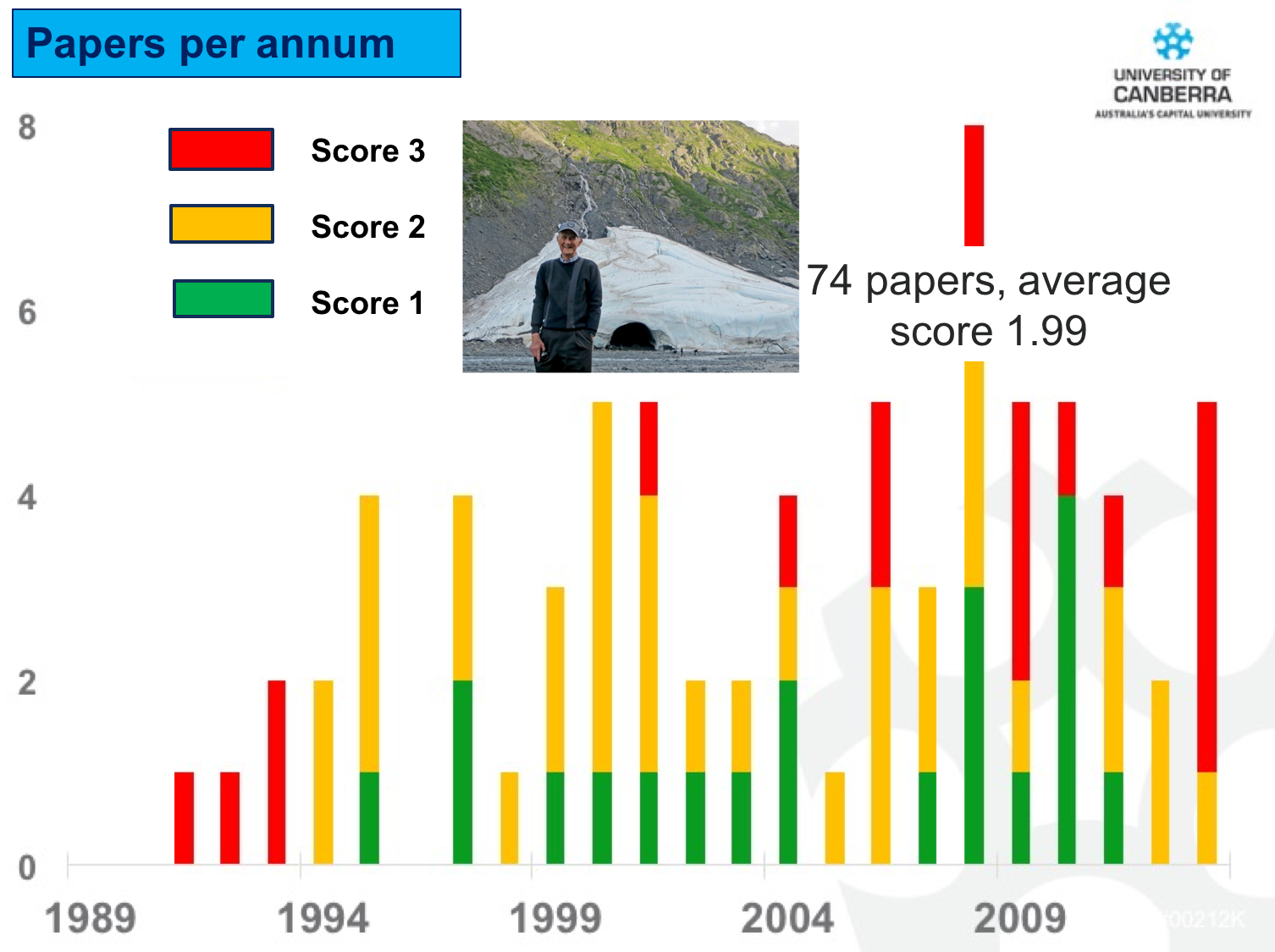
The average score of Tony's 74 papers was 1.99 (see figure). I mentioned this last week, when I had the chance to talk at the Public Health Association of Australia's 2018 conference, after I received the 2018 award for public health, ecology and environment, named after Tony McMichael. The slides for my talk ("From life support to regional overload") are here

The press release for this award stated that I see civilization at risk, not life, if we continue the current trajectory of fossil fuel burning (and other approaches to planetary boundaries). This is not because it may become so warm that there may again be crocodiles and palm trees in the Arctic Circle, but because the chaos that will be inflicted upon human society through many processes associated with "regional overload" (of which unfavourable climate  change is but one) are likely to outweigh human coping capacity. Here are three candidate contributors, in no order: (1) drought, heat and rising food prices triggering more political instability; (2) sea level rise on the US East Coast leading to a massive loss in property values and thus worsening a financial crisis; (3) a mass human flight from north east China later this century, due to intolerable heat and humidity. 

Even now, solutions might be found. The technology for electricity and elective transport is rapidly advancing. California seeks to be 100% carbon free by 2045. Education reduces fertility (reduced fertility in many settings is important, not to slow climate change, but to reduce climate change related catastrophes in the global South). But these solutions need high level recognition by our political leaders, and that needs the global middle class to understand that rapid transition, towards sustainability, is both urgent and attainable.   

PS Later this month I am teaching, in Finland, in a short course on climate change and health, based on my edited book. (I have just agreed to edit a second edition but it will take some time.)

PPS Prime Minister Modi is reported as saying that:
1. He saw the 121 country International Solar Alliance as the future OPEC for meeting energy needs of the world
2. India would add as much as 50 GW (gigawatts) of non-hydro renewable energy to its existing 72 GW and is on track to reach its target of 75 GW of clean energy by 2022
3. That India’s solar energy increased by nine times in the last four years
4. That in the next four years as many as 28 lakh (2.8 million) solar pumps would be installed which would help avoid 10 GW generation capacity. 
5. 31 crore (310 million) LED bulbs were distributed

50GW is a lot - according to the 2018 Clean Energy Report less than 6 GW of large scale renewable energy projects were under construction or expected to start in 2018, in Australia.


Tony McMichael's 74 papers (1989-2013 inclusive) on climate change and health, scored by their recognition of existential risk.

Thursday, December 21, 2017

Planetary health, civil disobedience and the age of hubris

This is adapted from an article published in Croakey, called A call to civil disobedience as we face a planetary healthemergency .

On December 14, 2017 the University of Sydney launched a new Planetary Health Platform, with high-level support from within the university and from leading figures in global health, notably Drs Helen Clark, until recently head of the UNDP, and Richard Horton, the long-standing editor of the Lancet.

By cosmic coincidence, earlier on the same day, what may turn out to be Australia’s (and even the planet’s) largest-yet, civilly disobedient planetary health protest by health professionals was reaching a crescendo, over 2,000 kilometres to the north, four hours drive inland from Bowen, Queensland.

Fifteen pioneering planetary heath protectors took part: three public health physicians, two other medical doctors (a geriatrician and a GP), two veterinarians, three nurses, four allied medical practitioners and a medical student. Two of the public health physicians were tethered to gates by bicycle locks around their necks and were arrested, along with three nurses, who refused to obey police commands to leave.

This group was protesting a vast proposed coal mine, aimed to take the carbon formed by ancient sunlight from the vast Galilee Basin, home of the Wangan and Jagalingou peoples. The mine, if built, will be operated by Adani, a giant Indian conglomerate that has extensive investments in renewable energy (including in Queensland), and which has been linked with alleged money laundering and other forms of corruption. A huge, though unknown volume of ancient underground water will also to be given to the mine by the people of Australia, some of it to be contaminated.

Four hundred kilometres from the mine, ships are planned to leave from Abbott Point, facing the Great Barrier Reef, itself dying due to global heating, to carry coal away for burning, to provide energy, but to further pollute sky and ocean. To reach port, coal must be transported along a costly, barely started railway line. The protest occurred at the entrance to a camp making a tiny start on the railway, the funding of which has been turned down by a slew of banks (even from China), but not yet by the hapless Australian taxpayer. If the railway is built it will be an investment in futility (a "stranded asset") and a massive opportunity cost.

Civil disobedience and public health

Health workers in Australia and other democracies have an honourable history of engagement in civil disobedience, most famously in the “BUGA-UP” campaign, which saw the creative defacing of numerous pro-tobacco billboards, the existence of which can now barely be imagined in Australia. Some graffiti artists were arrested.

In the early 1980s about 1,500 people were arrested in Australia’s largest campaign of civil disobedience to date, against Tasmania’s proposed Franklin Dam. While some of those arrested were health workers, and the campaign was led by a former GP (Bob Brown), the passion which led so many to risk their career, at that time, was mainly environmental.

In 2004, Dr Peter Pullinger (a dentist), Dr Frank Nicklason (a geriatrician) and a Victorian group called Doctors For Native Forests were three of the parties sued (for damages exceeding $6 million) by the Tasmanian woodchipper Gunns, in a case that came to be known as the "Gunns 20", one of many attempts by corporations to stifle dissent, a classic strategic law suit against public participation, as described by Sharon Beder in her book "Global Spin: The Corporate Assault on Environmentalism".

The anti-nuclear organisation ICAN, awarded the 2017 Nobel Peace Prize, has many of its roots in health, including in Australia, and there is a long and noble tradition of civil disobedience in the name of peace, including by some health professionals who clearly see the health risk of conflict.
However, only a handful of health workers that I know of, perhaps as few as 11, have previously been arrested in Australia as part of civil disobedience campaigns trying to awaken the public, including fellow health professionals, to the profound health dangers from global heating and weather wilding. Several other health professionals, especially nurses, have also been arrested as part of less focussed protests against Australian coal mines.

Until 2017, the largest such group of health workers (at least in Australia) prepared to do this was Medics Against Coal, about a dozen health workers, four of whom were arrested at the Maules Creek coal mine in NSW, in early 2014.

Although that protest entailed considerable effort, this latest protest near Bowen involved far more due its remoteness. The 15 health workers involved travelled over 50,000 kms return.

December 14, 2017: A planetary health landmark

Such intense effort and sacrifice, neither to make money nor to gain power, but to defend a principle, is an important landmark for planetary health, not only in Australia but worldwide. Many readers sympathetic to this blog will have signed petitions, and some will have contacted their local politicians, to try to promote “public goods” for health, such as clean air, clean food, clean water and other aspects related to social justice. Some will have marched, and some may also have risked arrest to protest Australia's flouting of the refugee convention, which it ]signed over six decades ago. But, for very good reasons, not many will have been arrested in the name of public health.

Civilly disobedient Australians will not face the ordeals of the English suffragettes or Chartists. And, on many occasions, Australian police have failed to make arrests concerning climate protection, in order to minimise public attention to the opposition to the issue which former Australian Prime Minister Kevin Rudd correctly identified as the greatest moral issue of our age.

Compare this to suffragettes, some of whom were force-fed through naso-gastric tubes inserted against their will. Leading Chartists at the Newport rising (1839 in Wales) were the last in Britain to be sentenced to the medieval torture of being hanged drawn and quartered, before having their sentence commuted to transportation to colonies such as NSW and Van Diemen’s Land. (Some Chartists were violent in that protest, but many were peaceful. Those who were violent appear to have been provoked, and the facts are contested. I am yet to find out if anyone other than Chartists were killed, given how victors write history, you would think if the rebels, armed mainly with pikes, had killed any of the soldiers then it would have been widely reported.)

Though civilly disobedient health workers have rarely, if ever, been imprisoned in this country (for more than a few hours), this does not mean that Australian authorities are benign.

When I was arrested at the Maules Creek coal mine in late 2014 (as a health worker, but as part of a group organised by the Australian Religious Response to Climate Change), I was charged with damaging mine property, which carries a maximum seven year jail term. On the charge sheet I was advised that I would have to repay the mine at least $40,000, as compensation for the damage I had allegedly caused, by blocking a road for 50 minutes. Thankfully, this threat was revoked.


Part of my charge sheet, given to me during my 2014 arrest

One consequence was that, two months later, I was unable to attend the Lancet Rockefeller Commission Planetary Health Commission meeting in New York City (as the only Australian reviewer) because the US refused to grant a timely visa. When I renewed my medical registration in 2015, a police check was required, and at the time of writing I am seeking another, this time to attempt to visit Canada for a meeting about Limits to Growth and health, relevant to planetary health.

Humility, hubris and the Australian government

In his lecture to the planetary health launch, Horton suggested the world is leaving an “age of hubris” for an “age of humility”. But hubris still characterises most of the Australian political elite, not only with regard to climate change but many other aspects of planetary health.

In 2015 Josh Frydenberg, then Minister for Resources, claimed that Australian coal exports to India were a moral imperative, to help reduce poverty.

But Horton, a cricket fan, had used, in his talk, a slide which showed the vast global burden of particulate air pollution, including in India, some of it from coal. Also this month, a Sri Lankan fast bowler became obviously ill from Delhi’s filthy winter air. Had the match been played in summer, heat exhaustion may have resulted, also in part due to the combustion of coal.

Frydenberg, whose own family was persecuted in Europe, showed in his claim a lamentably primitive understanding of the determinants of poverty and social exclusion in India. India exhibits, in its cities, a profligate waste of human and material resources (including energy), principally by its wealthy class of neo-rajahs (such as Gautam Adani) and its exploding middle class, some of whom are starting to rival Australians as planet wreckers, and whose behaviour, like that of Frydenberg, often reveals contempt for the poor.

Hundreds of millions of Indians are still afflicted by energy poverty. But the solution is not more coal-fired electricity. Frydenberg must be aware of the march of increasingly affordable solar energy in India and elsewhere, starting to enlighten villages and districts, including at a microscale.

Solar panels (and other inventions such as wind-up radios) can brighten and bring information to huts in which some of the most oppressed Indians still endure short lives blighted by coal dust (such as near the mines of Jharkhand) and the emissions of burning cow dung. While a handful of solar panels are, as yet, insufficiently powerful to solve the enormous challenge of providing smoke-free cooking and heating to rural India, Frydenberg’s view that the country’s cumbersome, often-corrupt bureaucracy will provide the infrastructure needed to deliver centralized electrical power to many such places is naïve, in a country in which caste discrimination and acid attacks are still commonplace.

The moral and economic failings of the Adani mine have been frequently highlighted in Australia, not only on the ABC’s Four Corners, but on social media that so many of our elected politicians still ridicule. One misrepresentation of the truth by Adani is particularly brazen and sad, disdainful to workers who crave economic and social security. This is its almost sevenfold exaggeration of the scale of permanent employment, admitted to by one of its own expert witnesses, when under oath. Given the long trajectory of large mines to replace humans with machines and artificial intelligence this overstatement is likely to prove even higher.

Coal combustion, combined with dazzling inventions, lifted hundreds of millions of people from poverty during the Industrial Revolution. Without coal, modern civilisation could not have been created. But today, fossil fuels are the chief poison of the Anthropocene, something China has recognized in its call for an eco-civilisation. In Australia, in the fleeting transition from soot-blackened workers to robots, coal mining briefly provided lucrative and comparatively safe and non-strenuous occupation to a few. This enabled a standard of living and health undreamed of by their mining forebears, who risked silicosis (black lung), and whose cousins in Jharkand and elsewhere still do.

Frydenberg and his advisors must also be aware of the boom in employment, both urban and rural, emerging from the generation of solar and some other forms of comparatively clean power, both in Australia and overseas, including in India. He may even have heard of visionary projects to ship clean power, captured in Australia, to Asia, such as from algal fuels or via lines transmitting clean energy. Were he and his government truly interested in reducing suffering in India, there is much he could do.
When Margaret Thatcher was in power, her government tried to strip tax deductible status from Oxfam, due to the charity’s opposition to apartheid in South Africa. Protests against apartheid protesters in Brisbane, in 1971, led to the declaration of a state of emergency. Opponents of behaviours now widely considered unacceptable were once savagely attacked by government. The removal of the social licenses for slavery, restricted voting and apartheid required courage in the face of indifference. In the future, fossil fuel burning and the other behaviours which erode planetary health will also lose their social license

A Planetary Emergency

We face a planetary emergency. If civilisation survives, it will be because of the courage of the few against the indifference and rapacity of companies like Adani and their political allies, some of whom, like Eddy Obeid, the disgraced NSW politician, are deservedly incarcerated.

Some health workers, who by their calling and training seek to help others, feel a duty of care to contribute to this struggle. The leading US climate scientist James Hansen (himself arrested four times, but not explicitly to protect health) has recently proposed that civil disobedience is not enough, and has instead called for greater legal action.

But neither course is sufficient, and both are necessary. The prominence of the Adani campaign in the recent Queensland election and the retreat of Premier Palaszczuk’s support for it demonstrates that the campaign is having a beneficial effect.

As climate change worsens, the world may see protests to slow its pace that rival or exceed that against the Vietnam War, the height of nuclear brinkmanship and the US-led invasion of Iraq. This movement is likely to evolve as people increasingly understand the enormous risk that climate change and many other forms of ecological destruction entails. 

Opportunity and responsibility

Health workers have a great opportunity and indeed a responsibility to become involved. As Richard Horton said at the launch of the Planetary Health Platform, the notion that the impact of health workers can be measured by grant income and articles in The Lancet does not apply in the age of humility.

And, as Helen Clark observed, in response to a question during the launch at the University of Sydney, protest is permissible in a democracy.

Climate change and other aspects of “planetary overload” constitute a slow motion planetary emergency. The plight of polar bears and Adélie penguins is bad enough, but very few people as yet understand the existential risk we face; our existence as a species is literally threatened. This risk to health is at least an order of magnitude higher than the conditions currently funded by the NHMRC.

It is very easy, using old world thinking (from the age of hubris) to dismiss visionaries such as René Dubos and Tony McMichael as “crying wolf” but we should recall the wolf did arrive.

We can and should use our voice to demand greater understanding of these issues among our peers and leaders at every possible opportunity.

 • Professor Colin Butler is Principal Research Fellow, College of Arts, Humanities & Social Sciences, Flinders University; Campus Visitor, National Centre for Epidemiology and Population Health, Australian National University; and Adjunct Professor, Health Research Institute, University of Canberra. He is also co-founder of the NGO BODHI Australia, which has supported development projects, particularly in India, since 1989.
Friday, February 10, 2017

Climate change and activism: time for protests to rival those against the Vietnam war

In late 2014 I was arrested at the Maules Creek mine, opposing coal exports, becoming the first Australian contributor to the Intergovernmental Panel on Climate Change (IPCC) to be arrested for coal disobedience. I don't regret that (even though it effectively ended my chances to go to the US again), but it has clearly been woefully inadequate.

Even Cory Bernadi should now be able to connect the dots

I originally wrote "Blind Freddy" instead of "Cory Bernadi" (an ultra conservative Australian politician) but it was pointed out me that this discriminates against the blind; apologies for that. The evidence of trouble from adverse environmental change is now overwhelming; but (to use another metaphor) we appear to collectively stand frozen, like a kangaroo in the headlights.

In recent days (continuing as I write at 03.30) there has been another infernal heat wave in much of Australia. In parts this has been compounded by blackouts. It's not only unpleasant, but can be highly dangerous and disabling, including to people with chronic cardiac, renal and neurological illnessses, including dementia, multiple sclerosis and epilepsy. Not to mention to people who are homeless, poor and in other ways vulnerable, including many who work outside, the elderly and some with mental illness. Added to this is the risk of devastating bushfires, including urban.

Note too that urban temperatures are often higher than officially recorded, due to the heat island effect, made worse by the killing of urban trees for cars and trams. Perth in Western Australia had its coldest February day ever, followed by an almost record deluge. That may seem paradoxical, but in fact climate change is not just about heating; it's also about the jetstream deforming (leading to paradoxical cold) and heavier rain, including "rainbombs". Parts of interior Australia have also been affected by significant extreme heat-associated infrastructure failure, including of mobile phones, the internet and the access to electronic cash

Australia: shooting itself in the brain

As civilisation gets closer to its apparent end we collectively seem to be functioning with less intelligence; just like a human being with advancing dementia. Part of civilisation is still alive and well - but those who can see the problems most vividly are probably aged between about 15 and 40 - and they lack the power to bring about real change. (Though this age cohort was very effective in ending our involvement in Vietnam.)

A scientific paper in Nature Climate Change has recently lamented the bias (I would say flagrant negligence) by Australia's National Health and Medical Research Council (NH&MRC) against funding research on climate change and health, most plausibly because they don't want to risk their political capital.  (Disclosure: when still an Australian Research Council Future Fellow, in 2014 - before I was arrested at Maules Creek - I led a research bid to establish a "centre of excellence" on global environmental change and health. It was the third NH&MRC climate and health related attempt I was involved with in 3 years, we paid great attention to the feedback from the bid in 2013, yet one review we received in 2014 was almost contemptuous.)

Three of our 15 proposed research projects concerned heat and health, others concerned conflict and climate change and the rest were about biodiversity loss, heat, infectious diseases, disasters and climate change. The Australian Defence Force was a willing partner, something I thought would at least make the NH&MRC take our bid seriously. The Australian Red Cross and two state health departments were also involved, as were the Chief Medical Officer and the Chief Veterinary Officer.

However, Tony Abbott ("coal is good for humanity") was then newly elected as Australian Prime Minister. I don't think it is paranoid to consider that the NH&MRC dared not risk offending "Captain Abbott" when the NH&MRC was itself vulnerable to further funding cuts?


South Australia's investment in renewable energy, which is a courageous step to protect us against extreme weather events, has been perversely blamed for blackouts, which are in fact more to do with climate change exacerbated storms and private enterprise profiteering. Federal ministers have even carried lumps of coal into the Australian parliament, which they seem to worship like icons. Professor Clive Hamilton has resigned from the Climate Change Authority. I don't blame him.

Even Mark Butler, the ALP shadow minister for environment, has failed to endorse the emergency phasing out of coal. We phased out asbestos; coal is even worse.

Do Australian politicians collectively lack leadership and courage, or do they inhabit such a bubble that they do not understand the immense risks the world now faces?  Or, perhaps, both?

In the US, a thoughtful article in the Atlantic, by David Frum, argues that protests, on their own, will shore up Trump's power. (The wilder the US political environment, the more his supporters in rustbucket states will appreciate Trump's autocracy.)

But Australia is a little more democratic. Just watching the world heat up, the weather to turn even wilder, and crops and animals to suffer is not going to do much good. 

Massive civil disobedience is needed - I wish it were more likely

I'm not sure that massive civil disobedience (on the scale of that against the Vietnam war) about coal in Australia will do any good, but just sitting in the frypan is futile. Such disobedience seems unlikely to occur, however, for several reasons:

1. Australians have many other stresses and priorities.


2. This heat wave will pass, and so will memory of it.

3. Globally, we are not like Syria or Yemen; we can afford food price rises, (see my open access chapter about food prices and climate change here) and we are already spending a significant sum deterring asylum seekers. Australians are not among the worst affected by climate change; we are still among the least affected. Here I disagree with some academics who point out our vulnerability - we are vulnerable, but we have the means to protect ourselves from the worst for a few more decades, though large urban bushfires scare me the most in Australia's near future. 

4. As inequality grows, so too does Australian public acceptance of the dreadfully named "harvesting effect" of heat on the vulnerable. 

5. The "eco-social" links between catastrophes such as in Yemen, Syria and South Sudan and adverse environmental change are substantially suppressed. (That is, these causes are ecological as well as social.) Since many academics deny, or fail to understand, such links what chance does the Australian media have of publicising them? Without widespread understanding of these factors, how will enough people be motivated to protest?

6. The Australian Federal and state governments will be increasingly draconian (I was initially threatened by the police with having to pay over $40,000 in compensation to the mine). The situation in Tasmania (where I was also arrested, opposing the Franklin dam) is also draconian, though Bob Brown is courageously challenging this. However the courts will probably be more sympathetic.

7. Finally, the massive (and entirely justified) protests in Australia and elsewhere against our participation in the 2003 invasion of Iraq were completely unsuccessful. That is discouraging.

Trying to end more positively

We truly are behaving like a slowly boiling frog. I wish I could be more positive. We need a new compact, a new economy, new leadership. President Trump may be replaced by Senator Warren. Like so many Australians I once had hope for Malcolm Turnbull, who I met in about 2011 - we talked then for ten minutes then solely about what I call the "tertiary" - civilisation wrecking - effects of climate change, and he seemed to understand. I think he probably still does, but he still feels he cannot dare risk the wrath of the Australian right.

I attended a moving funeral service for the late Professor Basil Hetzel two days ago (in the heat).  Basil was a very important mentor for the late Professor Tony McMichael. Basil devoted himself to public service and medical research, but had some understanding of the peril of the Anthropocene - the modern age. Tony, even more so, appreciated this. Former Australian Prime Minister Bob Hawke attended the funeral, and it was great to see him (at a distance). At the tea and sandwiches I spoke to a pastor who mentioned that Bob Hawke's accord was founded on a less adversarial approach to politics which had evolved in (convict-free) South Australia.

There is certainly something wrong with Federal politics at the moment, and not just here. We need more of what Thich Nhat Hahn calls "deep listening". Could this emerge as the world goes deeper in crisis? I think it might just be possible. In any case, despair does not help. Action to try to bend the world towards more justice is probably despair's best antidote. And, if anyone under 40 does read this, I hope you will contribute to the organisation of massive - but peaceful - protests. That is still a democratic right in Australia. Not everyone needs to get arrested.

--


Colin Butler is an adjunct professor of Public Health at the University of Canberra, Australia, and co-founder of the NGOs BODHI and BODHI Australia. He is founding co-chair of Health Earth and lead author for the section on health in the forthcoming flagship Global Environmental Outlook report of the United Nations Environment Programme, called Healthy Planet, Healthy People.


Monday, September 19, 2016

Limits to growth, planetary boundaries, and planetary health


Draft paper here: comments welcome*

This paper presents an overview of the “Limits to Growth” debate, from Malthus to Planetary Boundaries and the Planetary Health Commission. It argues that a combination of vested interests, inequalities, and cognitive impediments disguise the critical proximity to limits. Cognitive factors include an increasingly urbanized population with declining exposure to nature, incompletely substituted by the rise of simulated and filmed reality.

Following prominence in the 1960s and early 1970s, fears of Limits to Growth diminished as the oil price declined and as the Green Revolution greatly expanded agricultural productivity. While public health catastrophes have occurred which can be conceptualised as arising from the exceeding of local boundaries, including that of tolerance (e.g. the 1994 Rwandan genocide), these have mostly been considered temporary aberrations, of limited significance.

Another example is the devastating Syrian civil war. However, rather than an outlier, this conflict can be analysed as an example of interacting eco-social causes, related to aspects of limits to growth, including from climate change and aquifer depletion. To view the “root causes” of the Syrian tragedy as overwhelmingly or even exclusively social leaves civilization vulnerable to many additional disasters, including in the Sahel, elsewhere in the Middle East, and perhaps, within decades, globally.

An aspect of the Limits to Growth debate that was briefly prominent was “peak oil”. Fear of this has fallen with the oil price. But this does not mean that Limits to Growth are fanciful or will apply only in the far future, even if (which seems unlikely) the oil price remains low. The proximity of dangerous climate change is the starkest example of an imminent environmental limit; other examples include declining reserves of phosphorus and rare elements. Crucially, human responses have the capacity to accelerate or delay the consequences of these limits. 

Greater understanding of these issues is vital for enduring global population health.

Keywords: Anthropocene, civilization collapse, climate change, conflict, environmental determinism, human carrying capacity

* This was published as "Planetary overload, limits to growth and health" in Current Environmental Health Reports