The paper is designed to be read; some repetition is deliberate
Authors: Maxine Ross, Karunadeepa, Emilia Della Torre; Colin D. Butler
Summary: In 1956 the great reformer Dr Bhimrao Ambedkar led, in Nagpur, India, a mass conversion to Buddhism, involving at least 300,000 people. Millions more have since converted in an ongoing social movement, still keenly needed, reaching for greater justice in India, particularly for women, and particularly for Dalits, once called “untouchables”. Since 2005 the NGO BODHI Australia (founded in 1989) has supported the work of a team led by Karunadeepa, a Dalit whose grandfather took part in the historic Nagpur conversion, and who for decades has worked for an Indian NGO, based in Pune, India, itself largely supported by the UK Karuna Trust, allied with Triratna, whose founder (Venerable Sangharakshita) first met Dr Ambedkar in 1952. The work BODHI Australia has supported with Karunadeepa and her team mainly seeks to enhance the life-chances of slum-dwellers, especially migrants from rural Maharashtra (not necessarily Dalit, nor Buddhist) by improving education, health and awareness of family planning. In 2017 Karunadeepa, with Dalit colleagues, started to develop a new NGO, the Bahujan Hitay Pune Project, entirely governed by Dalit women, which will extend and deepen this work, but which also presents new challenges. In this talk, Karunadeepa, during her first visit to Australia, will discuss these activities, together with representatives of BODHI Australia. BODHI’s work to support Dalit-led and other development-promoting projects in India may seem a drop but can also be seen as a key to inspire, to resist oppression, to support development and to assist escape from poverty and vulnerability.
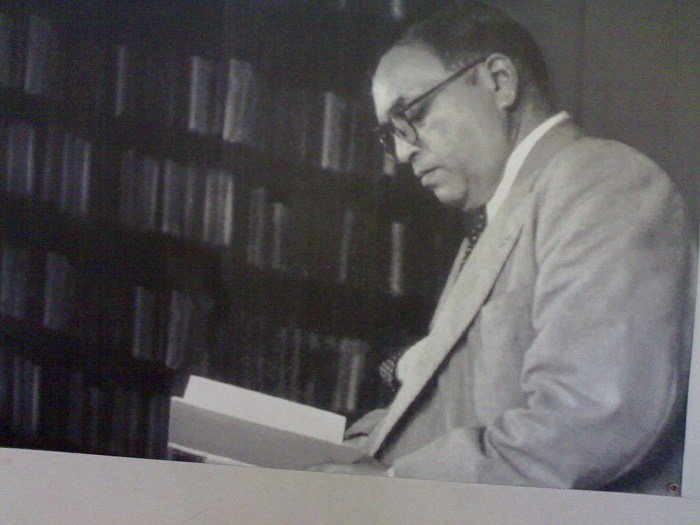
Dr Ambedkar. https://www.culturalindia.net/reformers/br-ambedkar.html original source unknown
This paper starts by acknowledging the traditional owners of the land this conference is held on, the Gundungurra, the Indigenous people who have thrived on this continent for at least 65,000 years. The authors of this paper are all apprentices of dharma. Between us, we have been exposed to about two centuries of close contact with Buddhism. One of us (Karunadeepa) was born Buddhist. However, none of us claim, or admit, deep knowledge of Buddhist scholarship. We thank the organisers of this historic conference for the opportunity to speak and to be published in this setting, alongside the work of people with far more scholarly knowledge of Buddhism than we will ever have.
The main motivation for this talk and essay is to provide information about the work of some followers (in Pune, India) of Dr Bhimrao Ramji Ambedkar, who lived in India from 1891 until 1956. Dr Ambedkar was 65 years old when he died, coinciding with the Buddha Jayanti festival, to honour Buddhism’s 2500th year. The Dalai Lama first arrived in India, mainly to attend this celebration, only a few days before Dr Ambedkar died.
 |
| Add caption
The traditional Buddhist dharma wheel,
representing interdependence and liberation, was added to the Indian national
flag at Dr. Ambedkar’s suggestion. Here it is on a stamp, issued to celebrate 2500 years of Buddhism. Source
|
While three of us were not born Buddhist, an important reason for our attraction to it is its links with social justice, or fairness, including its rejection of the principle that hereditarily transmitted inequality is legitimate. A basic teaching of many religions (maybe all of them) is the principle of cause and effect. In both Buddhism and Hinduism this principle is called karma, yet the dominant group in each of these two faiths, otherwise quite similar, appears to have a drastically different interpretation of this principle. Because we are not scholars, even more than from lack of time, we cannot trace these differences to early teachings. Instead, the observations in this paper are based mainly on our own personal experience, and our understanding of world events, both today and in the fairly recent past.
Whether or not there is a future life, the three authors of this paper, not born Buddhist, have all been, at various times, intensely moved by the unfairness of the social world, as was Dr Ambedkar, born a Hindu, but who converted to Buddhism in October 1956. This was in Nagpur, Maharashtra, in central India, at a mass gathering attended by over 300,000 people, one of whom was a grandfather of the fourth author of this paper, Karunadeepa, the only one of us who was born Buddhist.
In Australia, even among those of European descent, much inequality is passed through the generations, and along family lines, by privilege and unequal access to opportunity. Many people who are wealthy went to exclusive, expensive schools, where, in time, they send their own children. It is well-known, and not just allegation, that many rich people do not pay a fair share of tax. Mackenzie Bezos, the soon to be divorced wife of Jeff Bezos, the founder of the company Amazon, is reported to be due to receive almost US$70 billion in her divorce settlement. In so doing, she will become the richest woman in the world. Bezos, himself, is reported to have humble origins, the son of a teenage mother and a father who has been described as “deadbeat”. But his example of transition from hardship to fabulous wealth is more the exception than the rule.
Dr Ambedkar, who served as Law Minister in the first Indian government in 1947, was also exceptional. This was not through extraordinary entrepreneurial skills and alleged “robotization” of employees (the Bezos route), but from an vigorous and courageous intellect, some protection in childhood (due to descent from several generations of soldiers, including his father who rose to be an officer, in an army whose British leaders were far less caste-conscious than most Indians) (1) and hard work. Timing and history was also important. Ambedkar became a leading public figure through his central role in the struggle for Indian independence from Britain, recently reported as plundering the equivalent of $45 trillion from India during its long occupation (2).
We said that Dr Ambedkar was born Hindu. More accurately, as a member of the Mahar caste, he was born “untouchable”, meaning that close contact with him (even if indirect) was considered, by orthodox Hindus, to pollute or contaminate those who were conditioned, usually since birth, to consider themselves “higher born”, such as Brahmins.
For example, as a schoolboy, Ambedkar not only had to sit in a separate section at school (sometimes outside) but could not touch the tap if he was thirsty. In order to drink, a peon, considered “touchable” had to be found to turn it on.
Once, while travelling to visit his father, Ambedkar, aged 9, with a brother and two young nephews, all children, were stranded for over an hour at the station (following their first ever train ride), waiting for a servant that never arrived. The stationmaster was at first sympathetic to four well-dressed children, until discovering their lowly caste. Eventually, however, he helped them to find, with difficulty, a bullock cart driver, who agreed to take them to their destination, for twice the normal fee. But this was on condition that the children acted as driver while the driver walked, for fear of caste “pollution”. En route (on an overnight journey), as part of a harrowing ordeal, they were refused water (3).
Reflecting on this, Ambedkar wrote: “it left an
indelible impression .. before this incident occurred, I knew that I was an
untouchable, and that untouchables were subjected to certain indignities and
discriminations. All this I knew.
But this incident gave me a shock such as I had never received before, and it
made me think about untouchability--which, before this incident happened, was
with me a matter of course, as it is with many touchables as well as the
untouchables.
To non-Indigenous Australians the idea of caste might seem ludicrous. But there are traces of the caste system here too. We see it in films of past European royalty, and there are echoes in Australia’s treatment of asylum seekers and in the different punishments for white collar (executive) crime compared to those committed by blue collar wearers (working class). Discrimination based on skin colour, religion or age is officially banned (but persists) in Australia, though discrimination based on ability to pay is everywhere. We are nor arguing against laws and punishment, we are instead proclaiming support for the need for a fairer world, including of more equal opportunity.
Today, in India, the injustice of caste is milder, especially in urban areas, than in Dr Ambedkar’s time. This is partly due to Dr Ambedkar, partly to increased Westernisation of affluent Indians, and partly the work of liberal Hindus, such as the Ramakrishna mission. But chiefly, it is from the struggle and inspiration of tens of millions of people (sometimes called Dalits) who have renounced the legitimacy of caste as a concept. Karma may still exist, but it no longer can be unquestioningly interpreted as meaning, at least in India, that parental status and income completely determines one’s life course, though, naturally, the culture that children are reared in has a powerful “throwing” effect.
Many injustices still exist, in India and elsewhere, including for millions of “tribal” people. One group, seeking to reduce this injustice, and inspired by the teaching and legacy of Dr Ambedkar, is led by Karunadeepa. In 2017, with colleagues, almost all of whom are women, Karunadeepa started to develop a new non-government organization (NGO), called the Bahujan Hitay Pune Project. Since 1982, this work has been undertaken under the umbrella of a larger NGO, the Trailokya Baudha Maha Sangh Gana, but the time has come for a new, legally distinct group.
Bahujan refers to the people in the majority, meaning in India, “Scheduled Castes, Scheduled Tribes and Other Backward Castes”. Bahujan Hitay roughly translates as “for the welfare of many”. The work of the Bahujan Hitay Pune Project is principally with disadvantaged slum dwellers (scheduled castes and scheduled tribes) in this city of about six million, in the sprawling state of Maharashtra, parts of which are afflicted by drought and accompanying desperation, including farmer suicide. Consequently, many people migrate to Pune, seeking better conditions.
This work in Pune has, since 1982, been supported by the Karuna Trust a British charity founded by the late Ven Sangharakshita, who, as young man seeking to work for the good of Buddhism, based mainly in Kalimpong, in the Himalayan foothills, met Dr Ambedkar three times, including shortly before his conversion (4). Since 2005, this work led by Karunadeepa has also been supported by two NGOs with an Australian connection. These NGOs (BODHI and BODHI Australia) were co-founded by Colin Butler and his late wife Susan, in 1989. Since then, these groups have raised and distributed about A$0.5M to partners in six countries in Asia, mostly in India. The acronym means Benevolent Organisation for Development, Health and Insight. BODHI Australia also helps to support the Aryaloka Education Society, a Dalit-led NGO, based in Nagpur, which teaches basic computing skills, mostly to young women from poor villages.
In this talk, Karunadeepa, during her first visit to Australia, will discuss some of the activities of the Bahujan Hitay Pune Project. Four members of BODHI Australia’s committee, in addition to Karunadeepa, are attending the whole conference, and they hope to learn from and gain inspiration and encouragement from other individuals or NGOs engaged in similar development work.
 |
| Mrs Rubina Khan who trains slum dwellers in beauty therapy and hairdressing trainer. With permission.These three photos were taken in Pune, Maharashtra, India, in March 2018 (by Colin Butler) |
 | ||
| Mrs Sushma Chavan, an assistant teacher in the an assistant teacher at the Hadaspar balwadi (kindergarten) (Pune), with her two daughters. |
 |
| The boy (Aniketh) is soon to have surgery - provided for free by the Indian government. |
Whether or not there is a future life, we believe that the creation of good karma is important to try to reduce suffering, in this life. In our understanding of Buddhism, core values are compassion (karuna) and wisdom (panna or prajna), while the first Noble truth refers to the reality of suffering, not only of the perceiver, but also of others – human, animal and even Nature herself.
In the three decades of BODHI’s work the barriers facing partner organizations, in order to receive foreign funds have worsened. This steepens the challenge to reach the poorest people and to promote genuinely long-lasting development. But there is still great need. We ask for your support, either directly, or in many other ways.
References
1. Queen C. The Great Conversion. Dr. Ambedkar and Buddhist Revival in India. Tricycle. 1993.
2. Patnaik U. How the British impoverished India. Hindustan Times. 2018.
3. Ambedkar BR. Waiting for a visa. In: Moon V, editor. Dr Babasaheb Ambedkar: Writings and Speeches. Bombay, India: Education Department, Government of Maharashtra; 1993.
4. Sangharakshita U. Ambedkar and Buddhism: Windhorse Publications; 1986. Free pdf of book here.
3. Ambedkar BR. Waiting for a visa. In: Moon V, editor. Dr Babasaheb Ambedkar: Writings and Speeches. Bombay, India: Education Department, Government of Maharashtra; 1993.
4. Sangharakshita U. Ambedkar and Buddhism: Windhorse Publications; 1986. Free pdf of book here.
-->


